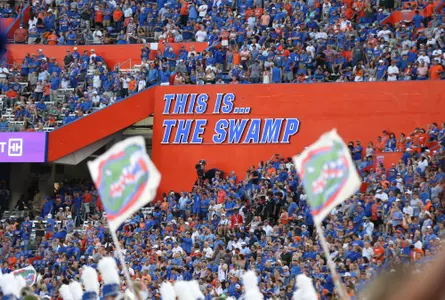
The renovation plans for Ben Hill Griffin Stadium took another step forward on Thursday. (Photo: UAA file photo)
Preserving The Roar: How Florida Plans to Reinvent an Icon
Friday, June 12, 2026 | Football, Scott Carter
Share:
By: Scott Carter, Senior Writer
GAINESVILLE, Fla. — When Florida and Alabama met on Nov. 8, 1930, in the first game played at Florida Field, neither the fans in attendance, legendary play-by-play broadcaster Red Barber, nor UF coach Charlie Bachman could have imagined what the stadium would become.
Nearly a century later, the University of Florida unveiled plans Thursday for a $1.45 billion transformation of Ben Hill Griffin Stadium, a sweeping project designed to preserve the character of "The Swamp" while preparing it for the next 50 years of college athletics. Scott Stricklin/UAA file photo
Located on the same plot of earth that Barber and Bachman walked, Florida Field has survived and thrived all these decades later – affectionately referred to as Ben Hill Griffin Stadium and "The Swamp" today – and according to the projected renovation plan released on Thursday, will celebrate in grand fashion its 100th birthday in 2030 and continue to serve as home of the Gators for years to come.
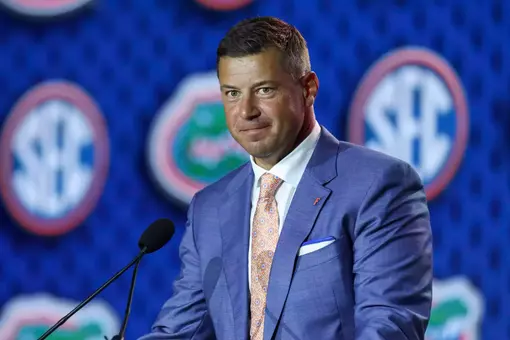
"I think when people walk into it for the first time, they are going to be blown away," UF athletic director Scott Stricklin said this week. "And the money is going to seem very well-spent. This is going to take a lot of resources, but I think it's also going to generate more resources than it takes in, and it's going to give us an advantage when it comes online."
UF and the University Athletic Association are eager to start a multi-phased project expected to take the next four offseasons, with work beginning soon after the 2026 season ends. The multi-sourced funding is expected to come from a combination of private giving, capital reserves, and long-term debt, through approval from the Florida Board of Governors.
While many details continue to be finalized, the key highlights of the renovation include maintaining the current stadium capacity (88,548), protecting the atmosphere in the venue's main bowl, a halo reminiscent of Green Bay's Lambeau Field built on top of the bowl that will include dozens of private suites and premium seating options, new video and audio components, and a wide array of upgrades to the fan experience from wider concourses to technology improvements.
In a message to UF alumni on Thursday, Board of Trustees chair Mori Hosseini wrote that the revamped Swamp "will breathe new life into one of the nation's most iconic college football venues and elevate it into the premier collegiate athletic destination that sets the standard for everyone else."
That was the assignment tasked to Stricklin and his UAA staff as the project evolved from its 2018 origins.
"What we heard from our fans is they want 'The Swamp' to be updated. I've heard that repeatedly,'' Stricklin said. "We know from interactions with fans one-on-one that there is a market for premium seating that we cannot currently provide. We also know we have some things we've got to do. It's a big checklist of what we're trying to accomplish.
"Every inch of this stadium is going to be affected. One of the duties and charges that our Board of Trustees gave us in working on this, don't do a short-term fix, make it a 50-year solution. We think we have followed that mandate."
The stadium has undergone other significant upgrades through the years, from the addition of lights in 1938 to a $50 million project completed before the 2003 season that added 2,900 luxury club seats, an expanded press level and 34 additional suites.
Stricklin took over as athletic director in November 2017 and has overseen construction of Condron Ballpark and the Heavener Football Training Center, two of the most ambitious UF athletic facility projects in history.
The Swamp project is massive in comparison and will be the largest financial renovation in the history of college sports.
"We have an incredible demand for the product, of coming and watching the Gators in 'The Swamp.' This project will generate a great deal of excitement that only will increase that demand,'' Stricklin said. "There's going to be a price point for everybody who wants to come to these games."
After years of research and planning, the project has gained significant clarity in the past year. While the cost is significantly higher than the estimated $400 million reported in the original concept, UF and the UAA are determined to position the program and its fans for long-term success.
"We could have spent half this amount, and people would sit around and ask, 'What did you even do?' " Stricklin said. "And we would have lost about 10,000 seats. While there's a lot of new structure being built, it's still Ben Hill Griffin Stadium. The wing walls are still there. The first row of seats is just as close to the sideline as they've ever been. The rake of the bowl is the same. We have gone through great pains not to dramatically alter the bowl. We saw concepts where we were creating decks on the east side. It took away the character of what made it feel like 'The Swamp.' "
The most noticeable difference in the bowl will be wider aisles and hand rails, long overdue in the eyes of the Americans with Disabilities Act. Most of the expansion will be above the east stands and south end zone seats.
With the additional spaces being built to keep the stadium capacity the same, the crowd noise that has made 'The Swamp' one of the most intimidating places for opponents in all of sports won't fade into the past.
"This is going to be a louder environment,'' Stricklin said. "More structure is going to hold in more sound."
The UF Committee on Facilities and Capital Investment approved Legend Global on Thursday to guide strategic planning and project delivery, and the Manhattan Construction Group and Hunt Construction Group will partner as the construction management team. The UF Board of Trustees approved those measures as well on Thursday afternoon. The full project is expected to go back before the Board in September for final approval.
You may have noticed the tagline on the project's website: Bigger. Better. Louder.
As the project began to take shape, Stricklin attended a game at Lambeau Field and sat in the lower bowl with diehard Packers fans. He wanted to experience Lambeau the way most Gators fans experience "The Swamp."
He left with a more convincing idea of what the revamped Swamp experience can be for those who call it their home away from home. And why this project is important as college athletics navigates uncharted territory.
"Florida football is obviously the sport that drives the most engagement and helps support the entire UAA and all 21 sports at a high level, and Ben Hill Griffin Stadium is by far the most important asset that Florida football has,'' Stricklin said. "It's really important that we, as an association and university, invest back into this really important asset to make sure that it can not only continue to support our fans and our team, but help the program grow as we move forward, where resources are going to continue to be really important."
In its long and iconic life, "The Swamp" has evolved with the times. Thursday's announcement marked the launch of a new era, tying the days of Barber and Bachman to the present and, more importantly, to a future that ensures the Gators' home remains unlike any other.